7th October 2026
The Most Rev. Peter Baldacchino
Bishop of the Diocese of Las Cruces
DIOCESAN SYNOD 2026
Cathedral of the Immaculate Heart of Mary
Las Cruces, New Mexico
Brothers and sisters in Christ,
How did the Church get to this Feast Day?
In the early church one became Christian generally as an adult, following a long period of preparation and initiation into the Faith. It was not a simple meeting with the priest. It was a long itinerary of conversion that lasted a few years. During that time one received instructions, catechesis, demonstrated a change of life, came to understand the Scriptures, and celebrated a living liturgy.
Scripture was the daily bread of ‘catechumens.’ That’s what those people who are engaged in this long journey of preparation for baptism were called: “Catechumens.”
During the first centuries of Christianity the entire people, not only priests, monks, prayed the Psalms every day. And they could do that because they understood the Psalms, because they had received a thorough and precise preparation to understand the Psalms. Furthermore, the Psalms were the prayer of Jesus. In the Gospels, when Jesus speaks to the disciples, to the crowds, or when he prays, he oftentimes uses the Psalms. He even uses a Psalm at the very end of his earthly life saying “my God my God why have you abandoned me?” — a Psalm that is far from a cry of desperation (if you read it carefully); but rather, a Profession of Faith: a declaration of complete trust in the Lord who ultimately never abandons his children!
Christians started the day reciting the Psalms of Morning Prayer and ended the day with the Psalms of Vespers. They did so because the Psalms express very well our interior struggles, our trials, our tribulations, …the help and the graces one received from the Lord. Within the recitation (or the singing) of the Psalms, they kept a special place for the veneration of the Blessed Virgin Mary, with the singing of the “Magnificat” and other hymns. “Sub tuum praesidium” (under your refuge we hasten to take shelter, Mary) comes to us from the second century (A.D.). Later we find others, extremely beautiful, such as the “Ave Maris Stella” and the “Salve Regina.”
Everything changes with the arrival of the barbarian invasions! These arrive unexpectedly from the barbarian and pagan nations who ransack, steal, and burn. The Church befriends them and converts them as much as it can. The pagans however, do not enter the Church ‘one at a time’, through the lengthy preparation of the Catechumenate. On the contrary, they enter ‘en masse’, all together, without any preparation, along with their king, like the Franks with Clovis and the Longobards with their queen Teodolinda. They enter the church in one shot, all together, while still maintaining their pagan mindset, their pagan customs, having no knowledge of Sacred Scripture; …also because the majority of them hardly knew how to read!
What was the church supposed to do with them? To push them away would have meant to keep them away as ‘enemies’ and ‘pagans’. The Church welcomes them, even at the cost of watering down the rich wine of the Faith. It received them all, ‘en masse,’ little by little trying to have them grow in the understanding of the Faith, in the measure that they could. Since in this way the catechumenate had by now disappeared, the Church tried to provide them with some other form of preparation, even though this proved to be much lighter in content (/substance). The interior walls of the churches were painted with images of the life of Jesus and Mary so that those who could not read or understand — since they did not know Latin at this point — could at least watch with their eyes and contemplate (perhaps!) at least, the central events of the Faith.
Pagan feasts were given new meaning, a Christian interpretation: the Church Christianized the people through their feasts. In place of their pagan gods, the Church invited the people to invoke the Martyrs, those great witnesses of the Faith, that is to say the Saints.
The Psalms, which by now nobody understood anymore except within the walls of the monasteries — and many did not even know how to read(!); …the Church substituted the Psalms with the ‘Hail Marys’. Since there are 150 Psalms, so there will be as many ‘Hail Marys’, divided in 3 sets of 50, interspersed and accompanied by meditations on contemplations of the “Mysteries,” that is to say, of the most central and important moments in the life of Jesus and of the Christian.
This is how the Holy Rosary came to be: as a substitute for the most common prayer of the Church, that of the Psalms; a substitution made for the spiritual good of the people, amidst a people who no longer understood Sacred Scripture. They no longer understood the Word of God.
A chain of beads is then designed to help with the recitation of the Rosary. The mysteries of Christ and our salvation are divided into ‘joyful’, ‘sorrowful’, and ‘glorious’; that is to say, into the central moments of the Lord’s life ranging from the glory that was sung by the angels and the shepherds at Bethlehem to the glory of the ascension, until the birth of the Church at Pentecost. More recently (2002), Pope Saint John Paul II also introduced the ‘luminous’ mysteries.
Throughout the centuries the Holy Rosary received its popularity by the Order of friars who called the people to conversion through their itinerant preaching from town to town: mostly by the Franciscans and the Dominicans.
Confraternities for the recitation of the Holy Rosary are established, spreading devotion and veneration of the Blessed Virgin Mary even through sacred art. Just consider for a moment that the scene of the final judgment by Michelangelo in the Sistine Chapel portrays the risen Christ drawing two persons into Paradise by placing the Rosary upon them as a form of a chain that saves them from hell.
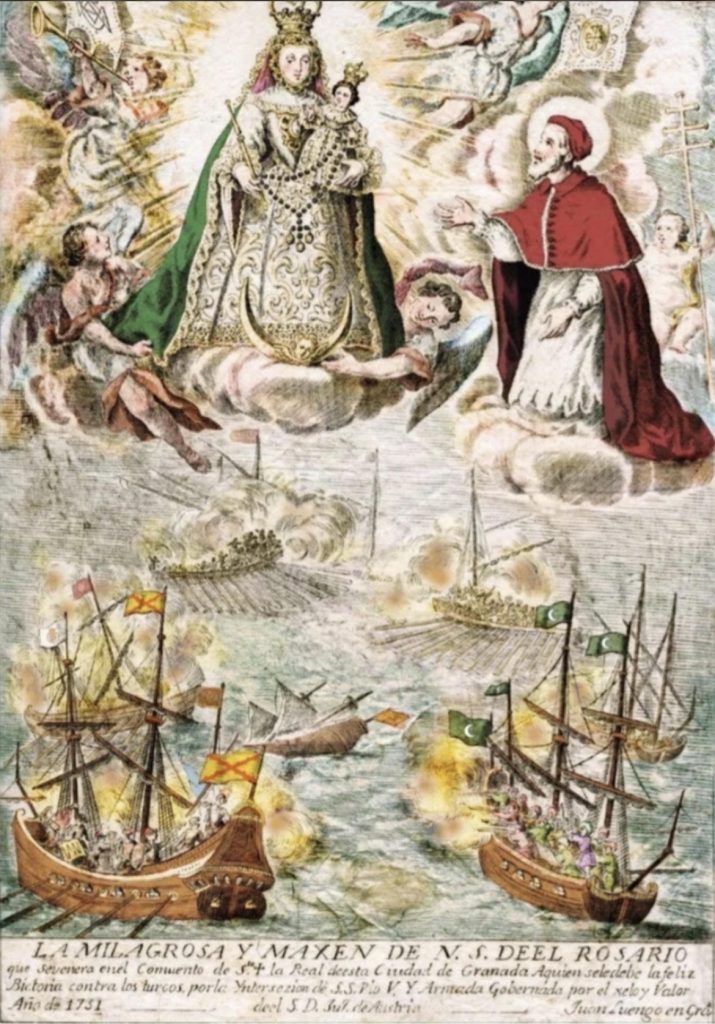
Later on comes the famous battle of Lepanto, wherein the West blocks the turko-saracene invasions that devastated Europe. During that battle, the Pope, Saint Pius Vth, prayed the Rosary placing his complete trust in the Blessed Virgin Mary and, in gratitude for the Victory over the Turks, instituted the feast of Our Lady of the Most Holy Rosary in the month of October.
In the meantime, the Popes recommended the recitation of the Rosary on various occasions, especially as an effective prayer that makes us humble. When we feel to be important, when we feel better than others, when we judge and despise others, it is good for us to get down on our knees and repeat the Rosary with its simple monotony. This helps to remind us that we are not as important as we think we are; we do not save anybody; we are children who should be falling on our knees to recover trust and abandonment to the will of God, following the example and with the help of the Blessed Virgin Mary.
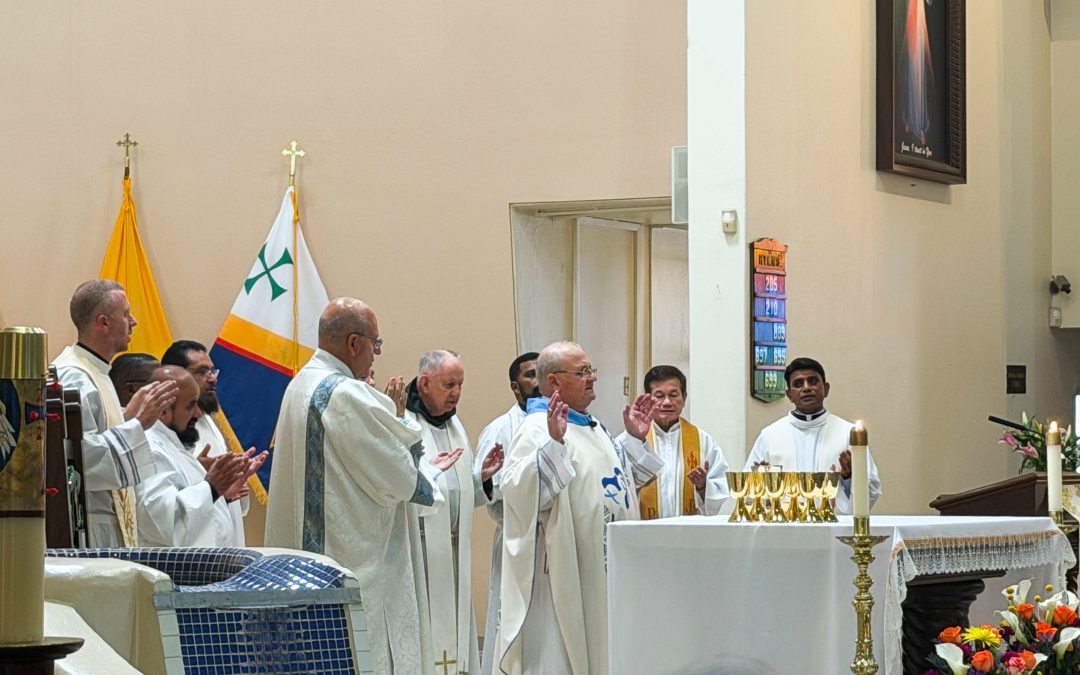
In today’s Gospel, the disciples ask Jesus, “Lord, teach us to pray.” During these two days of our Diocesan Synod, may that also be our prayer: before we speak, let us listen to the Father and to one another. Synod is not simply a meeting to exchange opinions, but a shared discernment shaped by prayer and listening. It is motivated by the Holy Spirit whom our Heavenly Father sends us to witness to his Son.
On this feast of Our Lady of the Rosary, Mary teaches us to keep our eyes on Christ. In the Rosary, we contemplate his life with her, and ask her to guide the Church’s journey. Saint Paul’s meeting with the leaders in Jerusalem reminds us that the Gospel is entrusted to the whole Church, and calls us to seek communion in our mission.
So let us ask for the daily bread of wisdom, the grace to forgive, and hearts open to the Holy Spirit. May our Synod help us walk together in Christ, and may Mary, Our Lady of the Rosary, accompany our diocese. Amen.