
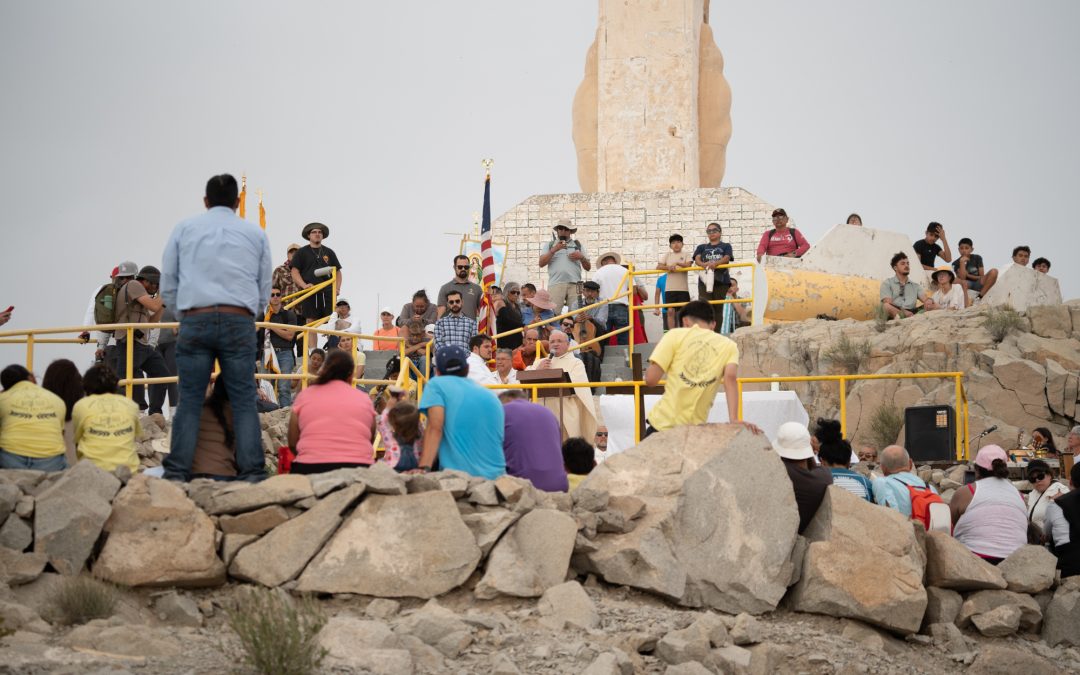
Mass at the feet of Christ the King
Mount Cristo Rey, Sunland Park – 28 June 2026
——————————————–
On Mount Cristo Rey, we came as a people from neighboring states and countries; but as we climbed up, we became family and we have now together placed ourselves at the feet of Christ the King. Today’s Mass is a prayer made visible: that the Church will be one, and that civil leaders will defend religious liberty so that the Gospel can be lived and worship can be freely offered.
The first reading shows us what unity looks like when it becomes real and concrete. In Shunem, a woman recognizes that Elisha is “a holy man of God,” and she responds not with vague goodwill, but with hospitality that is prepared, persistent, and personal—a place to stay, a bed, a table, a lamp.
Unity in the Church is never merely an idea; it is charity made practical, the willingness to make room for God—and for God’s messengers.
That theme deepens in Paul’s Letter to the Romans. Baptism is not a religious label, or your membership card; it is a participation in Christ’s own death and resurrection. We are “baptized into Christ Jesus,” “buried with him,” so that “we too might walk in newness of life.”
So, if Christ has brought us into new life, then unity must be more than social cooperation. It must be a transformed way of living—a newness that shows itself in how we welcome, forgive, and endure.
Then the Gospel explains the cost of that welcome. Jesus does not promise that discipleship will be comfortable. He says that whoever loves family “more than me” is not worthy of him, and whoever does not take up “the cross and follow me” is not worthy.
But in the very middle of these strong words, Jesus reveals why the cross is not just a burden—it is the path of love that creates communion. Because whoever welcomes a disciple “welcomes” Jesus; and whoever gives even “a cup of cold water” to “one of these little ones in the name of a disciple” will not lose their reward.
So, today’s readings form one connected line: make room for God and God’s people; live the newness of baptism; and welcome others in Christ, even when the cross is required.
Our pilgrimage to this mountain is a lived sign of something the Church has always known: unity does not erase differences—it transforms them into communion. At Pentecost, the apostles speak in many languages, and yet everyone understands; unity is not Babel’s forced sameness.
Likewise, our presence—from many dioceses and backgrounds—does not need to become identical in style to become truly united in Spirit. And that matters, because the Church’s unity is not the flattening of consciences. The Church teaches that the unity of faith and communion does not hinder “a diversity of vocations and of personal preferences,” but calls Christian liberty to be a real struggle for “totally objective truth” along with “patience with less robust consciences.”
Our pilgrimage, gathered around Christ the King, is a school for this kind of unity: same faith in essentials, real charity in differences, and the courage to pursue Truth together.
So, what does “unity” ask of us this week?
- Let us practice Elisha’s hospitality. Let us notice who is on the margins—visitors, the lonely, people who think differently, those who carry burdens we cannot see. Unity grows when we make “a place” for them, the way the Shunemite did for the man of God.
- Let us live baptism as newness. If we have been buried with Christ to rise into new life, then division cannot be fed by habit—by gossip, contempt, or silence when charity is required. Baptism means: walking in newness as one people.
- Let us honor Christ when it costs us. Jesus asks for priority: “whoever loves father or mother more than me” is not worthy of him, and the cross is part of following him.
That means unity may require personal sacrifice: swallowing pride, forgiving quickly, correcting without humiliating, and choosing communion over victory.
This pilgrimage is offered also as a prayer for our civil leaders, that they may act always “in defense of religious liberty.” The Church insists that religious freedom is not an optional charity—it is a basic right.
Religious liberty also protects the Church’s ability to serve publicly. Catholic teaching emphasizes that when religious freedom is sincerely implemented, the Church gains the legal and practical conditions for independence needed to fulfill her mission, including the public expression of the faith through institutions of charity and learning.
For that reason, praying for our leaders means asking God to give them not only tolerance, but the courage to safeguard the spaces where worship can be offered freely and where the Church can carry out her mission without unjust intrusion.
And because the Gospel is practical, praying must accompany living: we defend religious liberty not by abandoning the truth, but by practicing the Gospel in ways that become visible—our patience, our respect, our kindness to “little ones,” and our refusal to dehumanize opponents. Jesus promises that even a “cup of cold water” given in his name is never wasted.
Standing beneath Christ the King, we are not only commemorating a symbol—we are receiving a mission. The unity we ask for is the unity of baptismal life: welcoming without fear, living newness of life, and following even to the cross.
May Christ the King gather his Church into one communion of truth and charity. May he guide civil leaders to defend religious liberty in justice and peace. And may the Spirit make our pilgrimage today bear fruit that lasts.
Homilía del obispo Peter Baldacchino, Diócesis de Las Cruces, Nuevo México
Misa a los pies de Cristo Rey
Monte Cristo Rey, Sunland Park – 28 de junio de 2026
——————————————–
Al monte Cristo Rey llegamos como un pueblo proveniente de estados y países vecinos; pero, al ascender, nos convertimos en familia y ahora nos hemos postrado juntos a los pies de Cristo Rey. La Misa de hoy es una oración hecha visible: que la Iglesia sea una y que los líderes civiles defiendan la libertad religiosa, para que el Evangelio pueda vivirse y el culto ofrecerse libremente.
La primera lectura nos muestra cómo es la unidad cuando se hace real y concreta. En Sunem, una mujer reconoce que Eliseo es «un santo hombre de Dios» y responde no con una vaga buena voluntad, sino con una hospitalidad preparada, constante y personal: un lugar donde alojarse, una cama, una mesa, una lámpara.
La unidad en la Iglesia nunca es una mera idea; es la caridad hecha realidad práctica, la disposición a hacer sitio a Dios —y a los mensajeros de Dios—.
Este tema se profundiza en la Carta de San Pablo a los Romanos. El bautismo no es una etiqueta religiosa ni un carné de afiliación; es una participación en la propia muerte y resurrección de Cristo. Hemos sido «bautizados en Cristo Jesús», «sepultados con él», para que «nosotros también caminemos en una vida nueva».
Por tanto, si Cristo nos ha conducido a una vida nueva, la unidad debe ser algo más que una cooperación social. Es necesario que sea una forma de vida transformada: una novedad que se manifiesta en cómo acogemos, perdonamos y soportamos con paciencia.
Luego, el Evangelio explica el costo de esa acogida. Jesús no promete que el discipulado será cómodo. Dice que quien ama a su familia «más que a mí» no es digno de él, y que quien no toma «la cruz y me sigue» no es digno.
Pero justo en medio de estas palabras contundentes, Jesús revela por qué la cruz no es solo una carga: es el camino del amor que crea comunión. Porque quien acoge a un discípulo, «acoge» a Jesús; y quien da incluso «un vaso de agua fresca» a «uno de estos pequeños en nombre de discípulo» no perderá su recompensa.
Así, las lecturas de hoy trazan una línea continua: hacer sitio a Dios y a su pueblo; vivir la novedad del bautismo; y acoger a los demás en Cristo, incluso cuando ello exige cargar con la cruz.
Nuestra peregrinación a este monte es un signo vivo de algo que la Iglesia siempre ha sabido: la unidad no borra las diferencias, sino que las transforma en comunión. En Pentecostés, los apóstoles hablan en muchas lenguas y, sin embargo, todos comprenden; la unidad no es la uniformidad forzada de Babel.
Del mismo modo, nuestra presencia —procedente de muchas diócesis y entornos diversos— no necesita adoptar un estilo idéntico para estar verdaderamente unida en el Espíritu.
Y esto es importante, porque la unidad de la Iglesia no consiste en uniformar las conciencias. La Iglesia enseña que la unidad de fe y comunión no obstaculiza «la diversidad de vocaciones y preferencias personales», sino que llama a la libertad cristiana a ser una lucha auténtica por «la verdad totalmente objetiva», acompañada de «paciencia con las conciencias menos firmes».
Nuestra peregrinación, reunidos en torno a Cristo Rey, es una escuela para esta clase de unidad: una misma fe en lo esencial, verdadera caridad ante las diferencias, y la valentía de buscar juntos la Verdad.
Entonces, ¿qué nos pide la «unidad» esta semana?
- Practiquemos la hospitalidad de Eliseo. Fijémonos en quiénes están en los márgenes: los visitantes, los solitarios, las personas que piensan de manera diferente, aquellos que llevan cargas que no podemos ver. La unidad crece cuando les hacemos «un lugar», tal como hizo la sunamita con el hombre de Dios.
- Vivamos el bautismo como novedad de vida. Si hemos sido sepultados con Cristo para resucitar a una vida nueva, la división no puede alimentarse de la costumbre —de los chismes, el desprecio o el silencio cuando se requiere caridad. El bautismo significa caminar en novedad como un solo pueblo.
- Honremos a Cristo aun cuando nos cueste. Jesús pide prioridad: «quien ama a su padre o a su madre más que a mí» no es digno de él, y la cruz forma parte de seguirle.
Esto significa que la unidad puede exigir sacrificio personal: dejar de lado el orgullo, perdonar rápidamente, corregir sin humillar y elegir la comunión por encima de la victoria.
Esta peregrinación se ofrece también como oración por nuestros líderes civiles, para que actúen siempre «en defensa de la libertad religiosa». La Iglesia insiste en que la libertad religiosa no es una concesión caritativa opcional, sino un derecho fundamental.
La libertad religiosa también protege la capacidad de la Iglesia para servir públicamente. La enseñanza católica subraya que, cuando la libertad religiosa se aplica sinceramente, la Iglesia obtiene las condiciones legales y prácticas de independencia necesarias para cumplir su misión, incluida la expresión pública de la fe a través de instituciones de caridad y enseñanza.
Por eso, orar por nuestros líderes significa pedir a Dios que les conceda no solo tolerancia, sino también la valentía para salvaguardar los espacios donde se pueda rendir culto libremente y donde la Iglesia pueda cumplir su misión sin injerencias injustas.
Y como el Evangelio es práctico, la oración debe ir acompañada de la vida: defendemos la libertad religiosa no renunciando a la verdad, sino viviendo el Evangelio de manera visible—con nuestra paciencia, nuestro respeto, nuestra amabilidad hacia los «pequeños» y nuestra negativa a deshumanizar a quienes se nos oponen. Jesús promete que ni siquiera un «vaso de agua fresca» ofrecido en su nombre cae en saco roto.
Al situarnos bajo la mirada de Cristo Rey, no solo conmemoramos un símbolo, sino que recibimos una misión. La unidad que pedimos es la unidad de la vida bautismal: acoger sin miedo, vivir la novedad de vida y seguirle incluso hasta la cruz.
Que Cristo Rey congregue a su Iglesia en una sola comunión de verdad y caridad. Que guíe a los líderes civiles para defender la libertad religiosa en justicia y paz. Y que el Espíritu haga que nuestra peregrinación de hoy dé frutos duraderos.