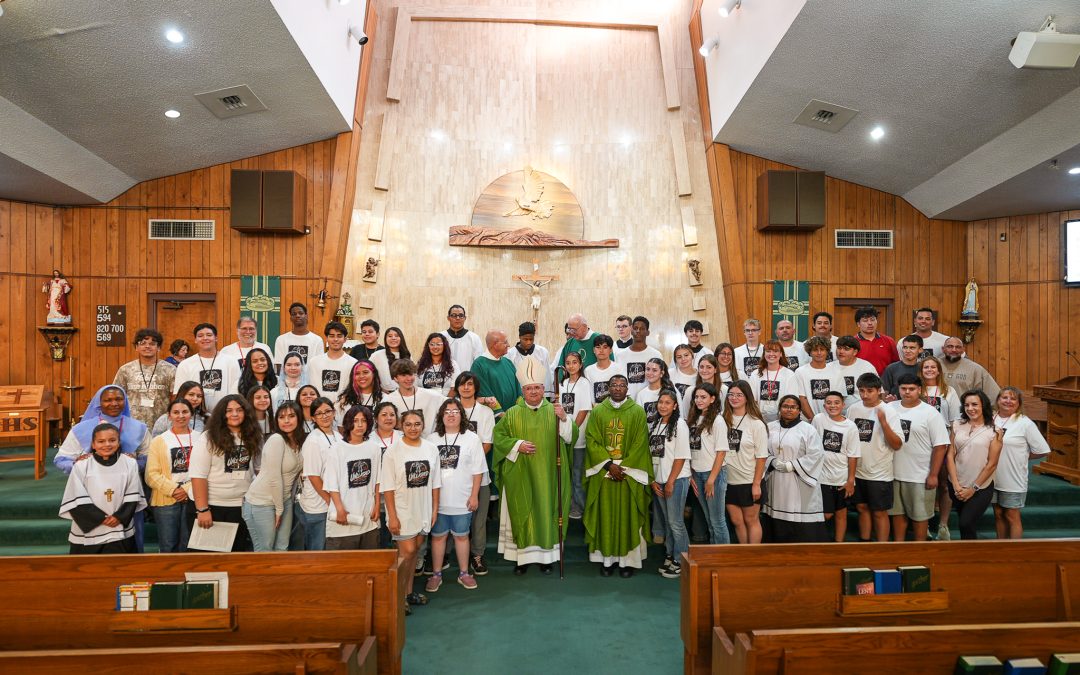
FROM THE CLOSING MASS OF THE YOUTH RALLY IN ALAMOGORDO – JULY 2026
The bishop opened with God’s invitation to Solomon and turns it on the assembly: “Today, through this Word, God addresses each one of us and says: ‘Ask me for what you desire.’” Solomon’s answer becomes the whole homily’s key—rather than long life or riches, “he acknowledges that he is ‘a mere youth’ and asks the Lord for ‘an understanding heart’… He does not seek mere intelligence or a storehouse of information. He asks for a heart able to listen to God, discern his will and serve others with justice.” This request, the bishop insisted, “concerns you as well, because you live in a world crowded with voices. Friends, advertisements, influencers and algorithms all try to tell you what to desire, how to look and who to become,” alongside “the voices of our own fears.”
From the Gospel’s buried treasure and the pearl of great price, the bishop pressed toward decision: “Christian faith is not born from having to give something up… It springs from an encounter with Jesus Christ and the discovery that in him the Kingdom of God has drawn near.” And that encounter demands a choice: “We all spend our lives on something. The question is not whether we will give our life, but to whom and for what.” He sharpened it into three questions: “What is your treasure? On what foundation are you building your life? And what kind of world are you helping to shape?”
The bishop then confronted the young people with technology and self-worth: “An algorithm can analyze your data and measure your performance, but it cannot tell you what you are worth… Artificial intelligence may simulate words of empathy and friendship, but it cannot replace an authentic relationship.” Against every measure of achievement, he sets their true dignity: “Your value does not depend on your achievements or the image you project. You are precious because God thought of you, willed you and loved you.” Even a broken history is not the last word: “hand that history over to Christ, so that evil may not have the last word.”
At the center stands the paschal proclamation and the Eucharist: “Christ has died and is risen for you… In the words of Pope Benedict XVI, Christ confronts the noisy power of this world with ‘the defenseless power of love.’” That mystery is meant to transform them: “In the Eucharist, Christ does not give us something; he gives us himself. The treasure we have sought comes to meet us as the Bread of Life.”
Finally, the bishop sent them out as builders: “The Church does not need only young people who attend an event. She needs young men and women who have found the pearl of great price and are ready to cooperate with God in making his dwelling visible among us.” He names the desert they are sent into—“loneliness, addiction, violence and fear”—and closes with a charge against a diminished life: “Do not settle for a small, closed-in life spent seeking comfort and approval. Do not sell your heart for something that tomorrow will have lost its value.”