Dear brothers and sisters,
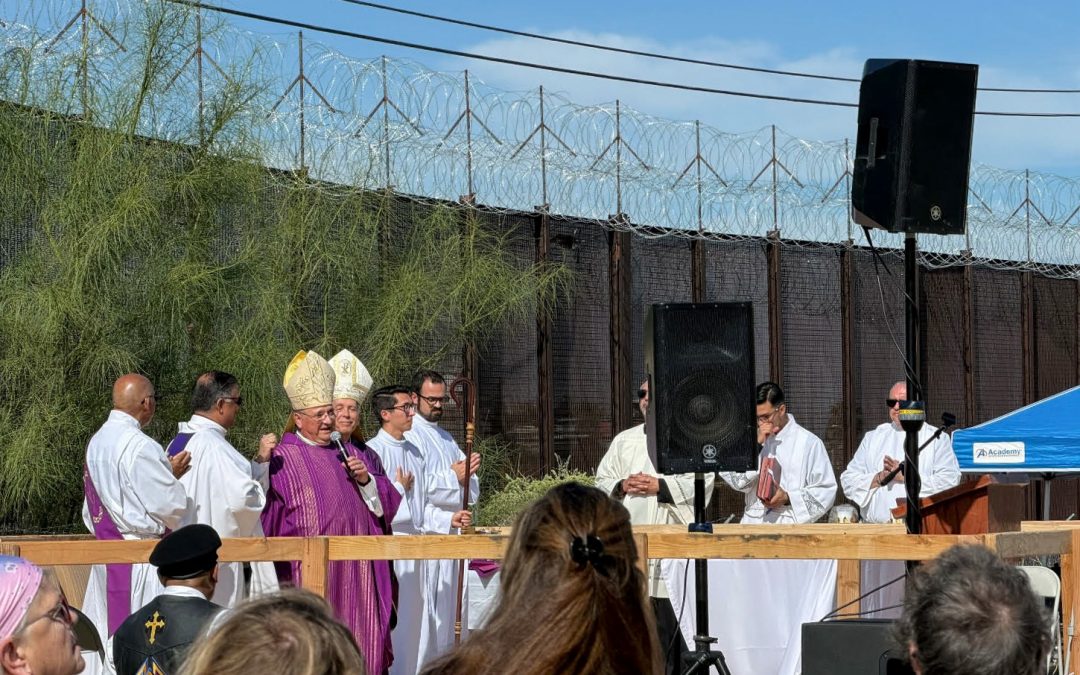
Dear friends gathered at the border,
Dear listeners of good will,
Queridos hermanos y hermanas,
Queridos amigos reunidos en la frontera,
Queridos oyentes de buena voluntad,
La primera lectura de hoy anuncia el banquete que Dios ha preparado para todos los pueblos. El profeta Isaías nos dice que el Señor destruirá la muerte para siempre y enjugará las lágrimas de todos los rostros.
Escuchamos estas palabras aquí, donde se han derramado tantas lágrimas, donde tantas vidas han sido heridas y donde personas inocentes han sufrido. Dios pone ante nosotros su promesa: nuestras vidas son valiosas para Él, y la muerte no tendrá la última palabra.
Hoy nos reunimos para rezar por las almas de aquellos que perdieron la vida al intentar cruzar la frontera —muchos de los cuales buscaban condiciones más seguras o estables para sí mismos y para sus familias— y para pedir a Dios que consuele a sus seres queridos con su presencia.
Recordamos a aquellos cuyos nombres conocemos y a aquellos cuyos nombres solo Dios conoce. Recordamos a sus familias, sus esperanzas y sus trayectos interrumpidos por la muerte. Hagamos sitio en nuestros corazones para cada uno de ellos.
El sufrimiento de los inocentes, especialmente el de los niños, es tal vez el mayor escándalo para la humanidad. También nos hace temblar a nosotros, personas de fe. ¿Dónde está Dios cuando un niño sufre? ¿Dónde está cuando una madre clama por su hijo? ¿Por qué permite que la violencia destruya a alguien que no ha hecho ningún mal? Estas preguntas surgen de corazones heridos. Debemos acogerlas con respeto y humildad. La fe no nos exige fingir que el sufrimiento es fácil de comprender.
Today’s first reading announces the banquet God has prepared for all peoples. The prophet Isaiah tells us that the Lord will destroy death forever and wipe away tears from every face.
We hear these words here, where so many tears have been shed, where so many lives have been wounded, and where innocent people have suffered. God places before us his promise: our lives are precious to him, and death will not have the final word.
Today we gather to pray for the souls of those who lost their lives while attempting to cross the border, many of whom were seeking safer or more stable conditions for themselves and their families, and to ask God to comfort their loved ones with his presence.
We remember those whose names we know and those whose names are known only to God. We remember their families, their hopes, and their journeys interrupted by death. Let us make room in our hearts for each one of them.
The suffering of the innocent, especially the suffering of children, is perhaps the greatest scandal for humankind. It also makes us, people of faith, tremble. Where is God when a child suffers? Where is he when a mother cries out for her son? Why does he allow violence to destroy someone who has done no wrong? These questions arise from wounded hearts. We must receive them with respect and humility. Faith does not require us to pretend that suffering is easy to understand.
En 2016, durante su visita a México, el Papa Francisco llegó a Ciudad Juárez y pronunció una homilía conmovedora. Habló de miles de personas que atraviesan montañas, desiertos y caminos inhóspitos, impulsadas por la pobreza, la violencia, el narcotráfico y el crimen organizado. Nos pidió reconocer a las personas detrás de la tragedia: sus nombres, sus historias y sus familias. Recordó a los jóvenes perseguidos al intentar escapar de la violencia y a las mujeres cuyas vidas fueron arrebatadas injustamente.
Nos recordó que siempre hay tiempo para cambiar, siempre una oportunidad para volvernos hacia la misericordia del Padre. Hoy, aquí en la frontera, escuchamos nuevamente ese llamado desafiante.
Parte del sufrimiento surge de decisiones humanas: la violencia, la codicia, la explotación y la indiferencia. Dios no nos pide llamar bien al mal. El mal debe ser reconocido, enfrentado y sacado a la luz. El amor exige que aliviemos el sufrimiento dondequiera que podamos y protejamos a aquellos cuyas vidas corren peligro. Sin embargo, el sufrimiento sigue siendo un misterio, incluso cuando comprendemos algo de sus causas. No podemos explicar cada enfermedad, cada pérdida, cada clamor sin respuesta.
Cada muerte también nos recuerda que somos mortales. Experimentamos miedo, impotencia y el dolor de la separación.
In 2016, during his visit to Mexico, Pope Francis came to Ciudad Juárez and delivered a powerful homily. He spoke about thousands of people crossing mountains, deserts, and inhospitable roads, driven by poverty, violence, drug trafficking, and organized crime. He asked us to recognize the people behind the tragedy: their names, their stories, and their families. He recalled young people persecuted when they tried to escape violence, and women whose lives had been unjustly taken.
He reminded us that there is always time to change, always an opportunity to turn toward the mercy of the Father. Today, here at the border, we hear that challenging appeal again.
Some suffering arises from human choices: violence, greed, exploitation, and indifference. God does not ask us to call evil good. Evil must be recognized, confronted, and brought into the light. Love demands that we relieve suffering wherever we can and protect those whose lives are in danger. Yet suffering remains a mystery, even when we understand something of its causes. We cannot explain every illness, every loss, every unanswered cry.
Every death also reminds us that we are mortal. We experience fear, helplessness, and the pain of separation.
El Salmo veintitrés, que hemos cantado, nos ofrece palabras de confianza en medio de nuestros temores y nuestro dolor. El Pastor nos acompaña a través del valle oscuro. Su presencia nos da valentía para dar el siguiente paso, incluso cuando no logramos ver el camino que tenemos por delante.
En medio de estas preguntas sin respuesta, Dios se acerca a nosotros en su Hijo. Reconocemos a este Pastor en Jesucristo, el Hijo de Dios que se hizo verdaderamente humano y compartió nuestra vida. Él conoció el hambre, el cansancio, la amistad, el dolor y las lágrimas. Sufrió la injusticia y la violencia. Está cerca de nosotros cuando sufrimos; nos acompaña y hace suyo nuestro sufrimiento.
Sin embargo, la misión de Cristo va más allá de acompañarnos en el dolor. En la cruz, Él carga sobre sí los pecados del mundo. Siendo inocente, entrega su vida por nosotros. Su sacrificio nos reconcilia con Dios y abre el camino al perdón. Él entra en el lugar al que el pecado ha llevado a la humanidad —incluso hasta lo más profundo de la muerte— para librarnos del poder del pecado y de la muerte. Su amor nos alcanza allí donde jamás podríamos salvarnos a nosotros mismos.
Psalm twenty-three, which we have sung, gives us words of trust amid our fear and grief. The Shepherd accompanies us through the dark valley. His presence gives us courage to take the next step, even when we cannot see the road ahead.
In the midst of these unanswered questions, God draws near to us in his Son. We recognize this Shepherd in Jesus Christ, the Son of God who became truly human and shared our life. He knew hunger, weariness, friendship, grief, and tears. He suffered injustice and violence. He is close to us when we suffer; he accompanies us and makes our suffering his own.
Yet Christ’s mission reaches beyond accompanying us in pain. On the cross, he takes upon himself the sins of the world. Innocent, he gives his life for us. His sacrifice reconciles us to God and opens the way to forgiveness. He enters the place where sin has brought humanity, even into the depths of death, to deliver us from the power of sin and death. His love reaches us where we could never save ourselves.
San Pablo anuncia: «Si creemos que Jesús murió y resucitó, de igual manera Dios, por medio de Jesús, traerá consigo a los que han muerto». Cristo está vivo. En su resurrección ha comenzado a cumplirse la promesa del profeta Isaías: la muerte no tendrá la última palabra. Él nos ama y viene hoy a nuestro encuentro en medio de nuestro dolor, para perdonar nuestros pecados y darnos su vida.
A través de la proclamación de la Iglesia y de los sacramentos, Cristo resucitado nos comunica el Espíritu Santo, dador de vida. En el Bautismo, el Espíritu nos hace hijos de Dios; renueva nuestros corazones y nos otorga la fortaleza y la sabiduría para servir a nuestros hermanos con un espíritu de amor y entrega.
Saint Paul announces: “For if we believe that Jesus died and rose, so too will God, through Jesus, bring with him those who have fallen asleep.” Christ is alive. In his resurrection, the fulfillment of the prophet Isaiah’s promise has begun: death will not have the final word. He loves us, and he comes today to meet us in our sorrow, to forgive our sins, and to give us his life.
Through the Church’s proclamation and sacraments, the risen Christ gives us the Holy Spirit, the giver of life. In Baptism, the Spirit makes us children of God; he renews our hearts and gives us the strength and wisdom to serve our brothers and sisters in a spirit of self-giving love.
La esperanza que recibimos de Cristo deja espacio para nuestras lágrimas. Le encomendamos a nuestros hermanos y hermanas cuya muerte recordamos hoy, rogando que los acoja en la plenitud de la vida junto a Él.
Nuestra fe se nutre de la vida de la Iglesia y del amor de nuestros hermanos y hermanas. A quienes lloran la pérdida de un ser querido, queremos acompañarlos y compartir su dolor, incluso cuando el sufrimiento persiste y el consuelo parece lejano.
The hope we receive from Christ leaves room for our tears. We entrust to him our brothers and sisters whose deaths we remember today, praying that he welcome them into the fullness of life with him.
Our faith is nourished through the life of the Church and the love of our brothers and sisters. To those of you mourning a loved one, we want to walk beside you and share your sorrow, even when the pain remains and consolation seems far away.
En el Evangelio de Mateo, el Señor se identifica con los hambrientos y sedientos, con los extranjeros, con los desabrigados, con los enfermos y con los encarcelados. Sus necesidades nos llaman a responder.
El Papa León XIV nos recuerda en su exhortación apostólica *Dilexi te* que encontramos al Señor en los pobres y en los que sufren. Como enseña el Concilio Vaticano II en *Lumen gentium*, la Iglesia reconoce a Cristo en ellos y le sirve al aliviar sus necesidades.
Por tanto, el Evangelio nos pide acoger, proteger y permanecer cerca de los necesitados, especialmente de los migrantes y sus familias. Estas acciones brotan de la vida que recibimos de Cristo.
Cuando ofrecemos alimento, visitamos a un enfermo, acogemos a un extranjero o nos sentamos junto a una familia afligida, el Espíritu nos enseña a amar con el amor de Jesús. Nuestra ayuda no puede responder a todas las preguntas, pero sí puede hacer que una persona que sufre sepa que alguien está a su lado. Aquí, el anuncio de la Iglesia se hace carne a través de la caridad de sus miembros.
In the Gospel of Matthew, the Lord identifies himself with the hungry and thirsty, with strangers, with those without clothing, with the sick, and with those in prison. Their needs call us to respond.
Pope Leo XIV reminds us in his apostolic exhortation Dilexi te that we encounter the Lord in the poor and suffering. As the Second Vatican Council teaches in Lumen gentium, the Church recognizes Christ in them and serves him by relieving their needs.
The Gospel therefore asks us to welcome, protect, and remain close to those in need, especially migrants and their families. These actions flow from the life we receive from Christ.
When we offer food, visit someone sick, welcome a stranger, or sit beside a grieving family, the Spirit teaches us to love with the love of Jesus. Our help cannot answer every question, but it can help a suffering person know that someone is standing beside them. Here the Church’s proclamation becomes flesh through the charity of her members.
La Iglesia lleva este Evangelio en manos frágiles, y todos necesitamos purificación y renovación. Pedimos perdón por las veces que no hemos sabido reconocer a Cristo en el prójimo. Quienes explotan o hacen daño a los demás están llamados a apartarse de ese mal; quienes son indiferentes, a acercarse y ayudar. Esta conversión permite al Espíritu vencer nuestro miedo y ensanchar nuestros corazones.
Hermanos y hermanas, a este altar traemos nuestras preguntas, nuestras lágrimas y a nuestros hermanos difuntos. Traemos también nuestros pecados y nuestra necesidad de dejarnos transformar por Dios. Cristo nos recibe y se nos entrega. Dirijámonos a Él con confianza: Señor Jesús, aumenta nuestra fe, danos tu Espíritu y enséñanos a amar a quienes sufren. Mientras aguardamos el banquete donde la muerte será destruida para siempre, caminemos juntos, consolémonos mutuamente y confiémonos al Pastor que nos conduce a la vida. Amén.
The Church carries this Gospel in fragile hands, and all of us need purification and renewal. We ask forgiveness for the times we have failed to recognize Christ in our neighbor. Those who exploit or harm others are called to turn away from that evil; those who are indifferent are called to draw near and help. This conversion allows the Spirit to overcome our fear and enlarge our hearts.
Brothers and sisters, at this altar we bring our questions, our tears, and our departed brothers and sisters. We also bring our sins and our need to allow ourselves to be transformed by God. Christ receives us and gives himself to us. Let us turn to him with trust: Lord Jesus, increase our faith, give us your Spirit, and teach us to love those who suffer. As we await the banquet where death will be destroyed forever, may we walk together, comfort one another, and entrust ourselves to the Shepherd who leads us into life. Amen.